What it is
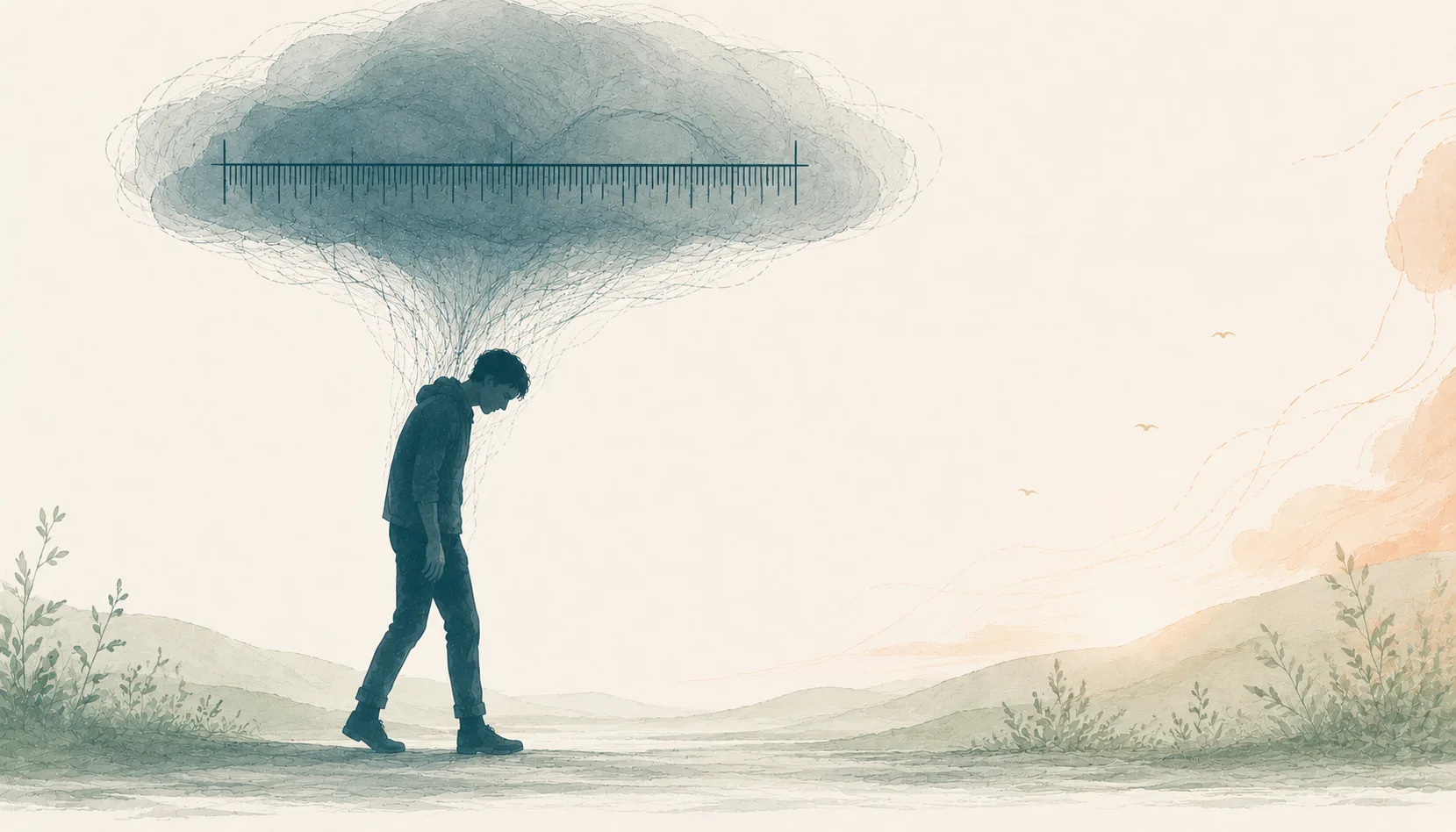
Should statements are the mind's rulebook running unchecked. 'I should be over this by now.' 'I should be further along in my career.' 'He should know what I need without me asking.' 'People should be more considerate.' Every 'should' creates a gap between how things are and how the rule says they ought to be — and that gap fills with bad feelings.
Albert Ellis, who studied this pattern extensively, called the most rigid version 'musturbation' — the mental insistence that things must be a certain way. The relief, when it comes, is in noticing that a should is not a fact. It's a preference dressed up as a law.
I should be handling this better. I should be stronger than this.
Why it happens
Shoulds are usually inherited. They come from parents, teachers, religious traditions, cultural messages, and the comparisons we make on social media. We absorb them without examining whether they're ours.
They also serve a function: shoulds feel like motivation. The mind hopes that if it pressures you hard enough, you'll improve. The reality is that should-driven motivation tends to produce guilt and exhaustion more reliably than it produces change.
- Notice the should. Every time the word appears — 'should,' 'must,' 'ought to,' 'have to' — pause and name it.
- Ask: whose rule is this? Where did this should come from? Is it a value you've chosen, or one you've inherited?
- Translate it into a preference. 'I should be over this' becomes 'I wish I were further along, and I'm not.' That sentence is honest. The should is not.
- Ask if the should is even accurate. 'I should be handling this better.' Says who? By what standard? Compared to whom? Most shoulds collapse under direct questioning.
- Replace shoulds with kindness. Talk to yourself the way you'd talk to someone you love going through the same thing.
A worked example
You're recovering from a breakup. Two months in, you're still sad. The should: I should be over this by now. The preference, honestly stated: I wish I felt better than I do. The reality: grief from a meaningful relationship takes longer than two months for almost everyone. There is no rule saying it should be over by now — there's just a preference, plus comparison to some imagined version of yourself who is more efficient at heartbreak. The kinder sentence: I am still sad, and that's an accurate response to what happened.
When to seek professional support
If this pattern is running constantly, if it's keeping you from sleeping, working, or being present with people you love, or if it's accompanied by hopelessness or thoughts of harming yourself — please reach out to a mental health professional.
This is not a weakness. Skilled help can shorten the time it takes to feel better, sometimes dramatically. See our list of low-cost and free options →
Sources
- Ellis, A. (1962). Reason and Emotion in Psychotherapy. Lyle Stuart.
- Burns, D. D. (1999). Feeling Good: The New Mood Therapy (revised ed.). Harper.
- Neff, K. D. (2011). Self-compassion, self-esteem, and well-being. Social and Personality Psychology Compass, 5(1), 1–12.