What it is
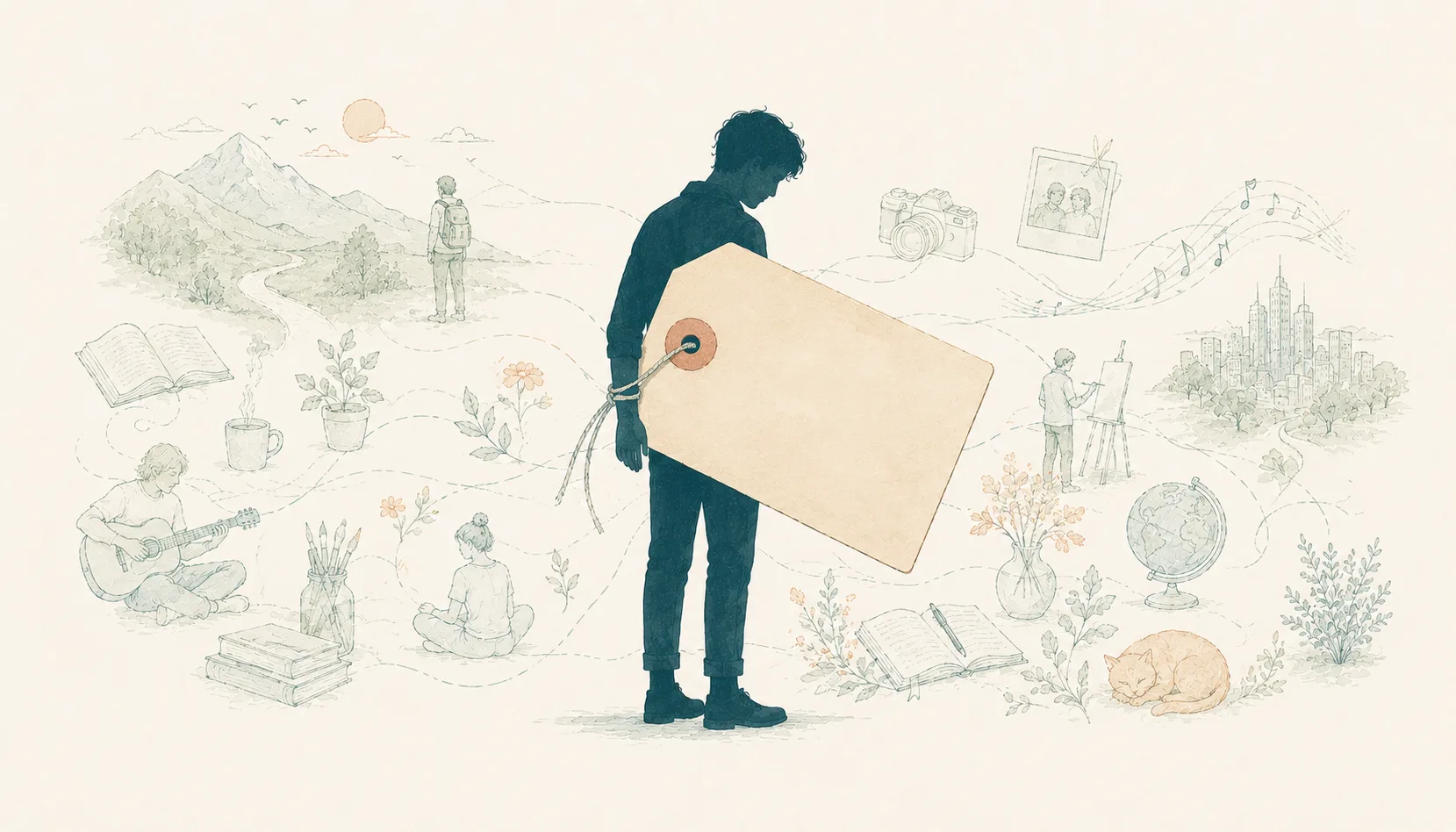
Labeling collapses a person into a single word. Instead of 'I made a mistake on that report,' it becomes 'I'm an idiot.' Instead of 'he was rude in that conversation,' it becomes 'he's a jerk.' The behavior — a specific, time-bound thing — gets replaced by an identity.
Identities are sticky in a way behaviors aren't. A behavior can be changed; an identity feels like a fact. That's why labeling is so corrosive: it converts ordinary mistakes into evidence of who you fundamentally are, with no apparent way out.
I forgot her name again. I'm such an idiot. I'm bad with people.
Why it happens
Labeling is often learned. Children who heard 'you're lazy,' 'you're difficult,' or 'you're too sensitive' grow up applying the same kind of language to themselves. The labels stop being external; they become internal narration.
It also serves a kind of explanatory function — labels feel like understanding. 'I'm an introvert' or 'I'm just an anxious person' can feel clarifying. But when labels become totalizing, they start limiting more than they explain.
- Separate behavior from identity. 'I made a mistake' is not the same as 'I am a mistake.' Practice using behavior language: 'I did this thing' instead of 'I am this thing.'
- Notice the global word. 'Idiot,' 'failure,' 'loser,' 'broken,' 'pathetic.' These words don't describe — they convict.
- Ask: would this label predict everything I do? If you're 'an idiot,' how do you explain every smart thing you've ever done? Labels can't account for the full data.
- Notice when labels run in your relationships. Labeling other people — 'he's selfish,' 'she's controlling' — closes the door on understanding their behavior in context. The same closure happens when you label yourself.
- Be specific instead. 'I forgot her name' is workable. 'I'm bad with people' is a sentence designed to make you give up.
A worked example
You snap at your partner during a stressful week. The label: I'm a terrible partner. I'm just a difficult person. The behavior-level description: I was short with them tonight. I was tired and stressed. That doesn't excuse it, and I can apologize and do it differently tomorrow. The first sentence forecloses change. The second one opens it.
When to seek professional support
If this pattern is running constantly, if it's keeping you from sleeping, working, or being present with people you love, or if it's accompanied by hopelessness or thoughts of harming yourself — please reach out to a mental health professional.
This is not a weakness. Skilled help can shorten the time it takes to feel better, sometimes dramatically. See our list of low-cost and free options →
Sources
- Burns, D. D. (1999). Feeling Good: The New Mood Therapy (revised ed.). Harper.
- Beck, A. T. (1979). Cognitive Therapy of Depression. Guilford Press.
- Gilbert, P. (2009). The Compassionate Mind. New Harbinger.